Every business decision starts with reliable information. Whether you're identifying new customers, researching competitors, evaluating suppliers, or entering a new market, having access to accurate business information can make all the difference. This is where B2B data plays a critical role.
Understanding what B2B data is helps organizations make informed decisions, improve targeting, and uncover new growth opportunities. In this guide, you'll learn what B2B data is, the different types of B2B data, why it matters, and how businesses use it to support sales, marketing, procurement, and strategic planning.
What Is B2B Data?
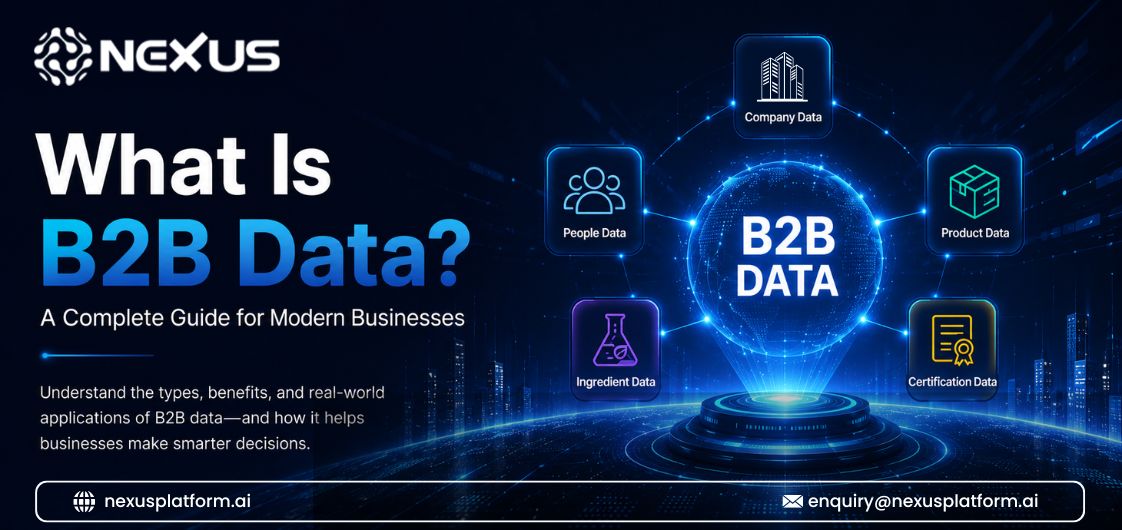
B2B data (Business-to-Business data) is information about businesses and the professionals who work within them. It helps organizations understand companies, their operations, products, decision-makers, and market presence.
Unlike consumer data, which focuses on individuals, B2B data is designed to support business relationships and commercial decision-making.
Definition: B2B data is business-related information about companies, professionals, products, and other organizational attributes that helps businesses make informed decisions across sales, marketing, procurement, and business intelligence.
Common Types of Information Found in B2B Data

Together, these data types provide a comprehensive view of a business and its operations.
Why Is B2B Data Important?
Businesses rely on accurate information to reduce uncertainty and make confident decisions. However, collecting data from multiple sources can be time-consuming and inconsistent. High-quality B2B data solves this problem by bringing together reliable business information in one place.
As a result, different teams can work more efficiently.
- Marketing teams can identify and segment their ideal audience.
- Sales teams can research prospects before reaching out.
- Procurement teams can evaluate suppliers with greater confidence.
- Business intelligence teams can analyze industries and competitors.
- Leadership teams can support expansion with data-backed insights.
When everyone works with trusted information, collaboration improves and decision-making becomes more consistent.
How Businesses Use B2B Data
Although every organization has different goals, B2B data supports a wide range of business activities.

For example, a marketing team might use firmographic data to target companies within a specific industry. At the same time, a sales team can use company and people data to identify key decision-makers before starting conversations.
Best Practices for Using B2B Data
Having access to B2B data is only the first step. Businesses also need to ensure the information is accurate, relevant, and up to date.
Follow these best practices to get the most value from your data:
- Verify business information regularly.
- Use multiple data points instead of relying on a single source.
- Keep company records updated as organizations grow or change.
- Combine different data types to build a complete business profile.
- Review data quality before making strategic decisions.
These practices help improve accuracy, reduce manual research, and support better business outcomes.
Conclusion
Understanding what B2B data is the first step toward making smarter business decisions. From company and people data to products, ingredients, and certifications, B2B data helps organizations understand the businesses they work with and the markets they operate in.
As companies continue to rely on data-driven strategies, accurate and connected business information becomes increasingly valuable. Businesses that invest in high-quality B2B data are better positioned to identify opportunities, improve efficiency, and make confident decisions in a competitive market.
Read more about: B2B Data
Discover Business Intelligence with Nexus
Finding reliable business information often means searching across multiple sources. Nexus simplifies this process by bringing together company, people, product, ingredient, and certification data into one connected platform. With access to comprehensive business intelligence, organizations can research companies more efficiently, uncover new opportunities, and make better-informed decisions.