Artificial intelligence has become remarkably good at answering questions. It can summarize lengthy reports, write emails, explain scientific concepts, generate code, analyze financial data, and even help businesses identify suppliers or research new markets. Its responses are often so fluent and confident that it's easy to believe AI understands the world just as humans do.
But that assumption is one of the biggest misconceptions surrounding artificial intelligence.
Despite how knowledgeable it appears, AI doesn't actually know anything in the way people do. It doesn't have experiences, beliefs, intuition, or an understanding of the world. It doesn't remember facts the way a person recalls a conversation or a historical event. Instead, AI generates responses by learning patterns from enormous amounts of data and, increasingly, by retrieving information from external sources.
Understanding this distinction is more than a technical curiosity. It explains why AI can produce brilliant insights one moment, confidently generate incorrect information the next, and why businesses are realizing that the quality of their information is becoming just as important as the AI models they use.
If you've ever wondered how AI works, the answer begins not with intelligence but with information.
Why AI Feels Like It Knows Everything
Ask ChatGPT to explain blockchain.
Ask it to summarize a 100-page report.
Ask it to compare two companies.
Within seconds, it delivers an answer that feels thoughtful, structured, and surprisingly human.
The experience creates an illusion of knowledge.
Humans naturally associate fluent language with understanding. When someone answers our questions confidently, we assume they know what they're talking about. AI creates the same impression because it has become exceptionally good at generating natural language.
However, generating language is not the same as possessing knowledge.
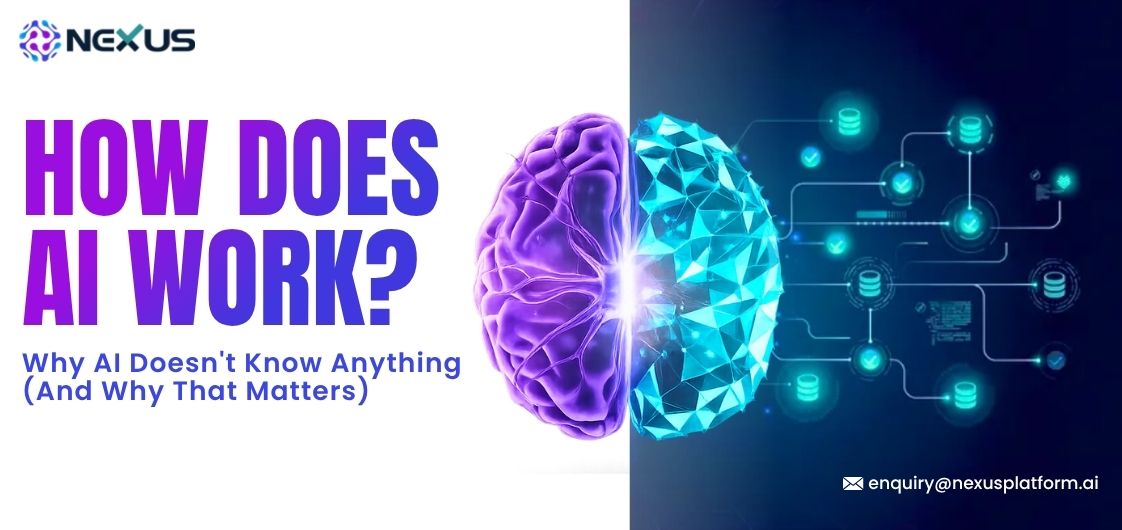
Modern AI systems, known as Large Language Models (LLMs), are designed to predict language. They identify relationships between words, sentences, and ideas based on patterns learned during training. Every response you receive is built one word or more accurately, one token at a time by predicting what is most likely to come next.
That's why AI often sounds intelligent. It has learned how knowledge is expressed, even though it doesn't experience knowledge itself.
How Does AI Work? It Learns Patterns, Not Facts
Imagine asking someone to read millions of books, research papers, articles, and websites over several years.
They wouldn't memorize every sentence. Instead, they would begin recognizing patterns how ideas connect, how language is structured, and which concepts frequently appear together.
AI learns in a similar way.
During training, machine learning models analyze enormous datasets containing billions of words. Using deep learning algorithms and neural networks, they learn statistical relationships between those words. They discover that certain concepts commonly appear together and that certain sentence structures are more likely than others.
When you ask AI a question, it doesn't search through a mental encyclopedia looking for a stored answer. Instead, it generates a response by predicting the sequence of words that best fits your prompt and the context of the conversation.
This process is known as Generative AI.
Rather than retrieving a pre-written answer, AI creates a new one every time.
This ability makes AI incredibly flexible. It can answer questions it has never seen before, adapt its writing style, and explain complex ideas in simple language.
But it also explains why AI can sometimes be wrong.
Why AI Hallucinates
One of the biggest challenges with generative AI is something known as an AI hallucination.
The term sounds dramatic, but the concept is surprisingly simple.
Imagine asking someone:
"Who won the Nobel Prize in Chemistry in 2038?"
Since that event hasn't happened yet, there's no correct answer.
A person would probably reply,
"Nobody knows yet."
An AI model, however, is designed to complete patterns. If it lacks reliable information, it may generate an answer that looks realistic because it resembles previous Nobel Prize announcements.
It isn't lying.
It isn't making a conscious decision to invent information.
It's doing exactly what it was designed to do predict the most probable response based on patterns.
Hallucinations can also occur when information is outdated, incomplete, conflicting, or unavailable. That's why even the most advanced AI systems should be viewed as powerful assistants rather than infallible experts.
If AI Doesn't Know Everything, How Does It Answer Questions?
This is where modern AI has evolved significantly.
The earliest language models relied almost entirely on what they learned during training. If information wasn't part of that training, the model couldn't reliably answer questions about it.
Today's enterprise AI systems often work differently.
Instead of relying only on learned patterns, they first retrieve relevant information from trusted sources such as databases, documents, knowledge bases, or business platforms. Only then do they generate a response.
This approach is known as Retrieval-Augmented Generation (RAG).
Think of two consultants.
One relies entirely on memory.
The other has instant access to an up-to-date library containing verified business reports, company profiles, technical documents, and market intelligence.
Who is more likely to give an accurate answer?
Almost certainly the second.
Retrieval gives AI access to information beyond what it learned during training, making responses more current, contextual, and reliable.

Why Structured Information Matters
Information alone isn't enough.
It also needs to be organized.
Consider researching a manufacturing company online.
Some information is on its website.
Some is buried inside PDF brochures.
Some appears in government filings.
Some exists in news articles.
Some is hidden inside product catalogs.
Humans can piece these fragments together, but AI performs much better when information is structured.
Structured data organizes information into clearly defined fields and relationships.
Instead of reading dozens of pages to determine whether a company manufactures botanical extracts, AI can access structured attributes such as:
- Company
- Industry
- Products
- Certifications
- Manufacturing capabilities
- Export markets
- Decision-makers
Modern AI also uses technologies such as embeddings ,semantic search , vector databases, and knowledge graphs to understand relationships between concepts rather than relying only on exact keyword matches.
The better information is organized, the better AI can retrieve, connect, and explain it.

Why This Matters for Businesses
Most consumers use AI to draft emails, summarize documents, or generate creative ideas.
Businesses ask very different questions.
They want to know:
- Which suppliers recently expanded into Europe?
- Which manufacturers hold specific certifications?
- Which companies produce a particular ingredient?
- Who is the Head of Procurement at a target organization?
- Which competitors launched new products this quarter?
These questions cannot be answered reliably through language prediction alone.
They require trusted, current, and connected information.
This is why AI is becoming increasingly valuable in procurement, market research, business development, R&D, and sales but only when it's supported by reliable business data.
Businesses aren't simply looking for answers.
They're looking for business intelligence.
The Future of AI Isn't Bigger Models. It's Better Information.
Over the past few years, AI discussions have largely focused on larger language models, faster hardware, and increasingly impressive benchmarks.
While those advancements matter, they're only one part of the equation.
The real competitive advantage is shifting toward information.
An AI model is only as useful as the information it can access.
If the underlying information is incomplete, outdated, or disconnected, even the most advanced model will struggle to produce reliable answers.
If the information is structured, verified, continuously updated, and connected across multiple sources, AI becomes dramatically more useful.
In other words, AI doesn't replace high-quality information.
It amplifies its importance.
Why This Is Changing Business Intelligence
For decades, businesses competed by collecting more data.
Today, data is everywhere.
The challenge is no longer finding information.
The challenge is organizing it, connecting it, and transforming it into intelligence that supports better decisions.
This is why a new generation of business intelligence platforms is emerging.
Rather than treating AI as a standalone answer engine, these platforms combine AI with structured business information that provides context, relationships, and real-time relevance.
Nexus is built around this philosophy.
Instead of asking AI to guess, Nexus provides the business context AI needs to generate more meaningful insights. By bringing together 10M+ verified companies, 12M+ decision-makers, 2M+ products, and 3M+ ingredient records into a connected intelligence ecosystem, Nexus helps businesses move beyond scattered searches and disconnected information.
Whether the goal is discovering suppliers, researching markets, identifying decision-makers, or exploring new business opportunities, AI becomes significantly more valuable when it's powered by structured, verified business intelligence.
Ultimately, the future of enterprise AI isn't just about building smarter models.
It's about building smarter information ecosystems.
Because AI doesn't create knowledge out of thin air.
It builds on the information we give it.
And in the age of artificial intelligence, businesses that combine powerful AI with trusted information won't simply get faster answers they'll make better decisions.