Businesses generate large volumes of information every day, but not all of it serves the same purpose. Understanding the types of B2B data lets marketing, sales, and procurement teams use the right information at the right time, instead of treating every dataset the same way.
What Are the Main Types of B2B Data?
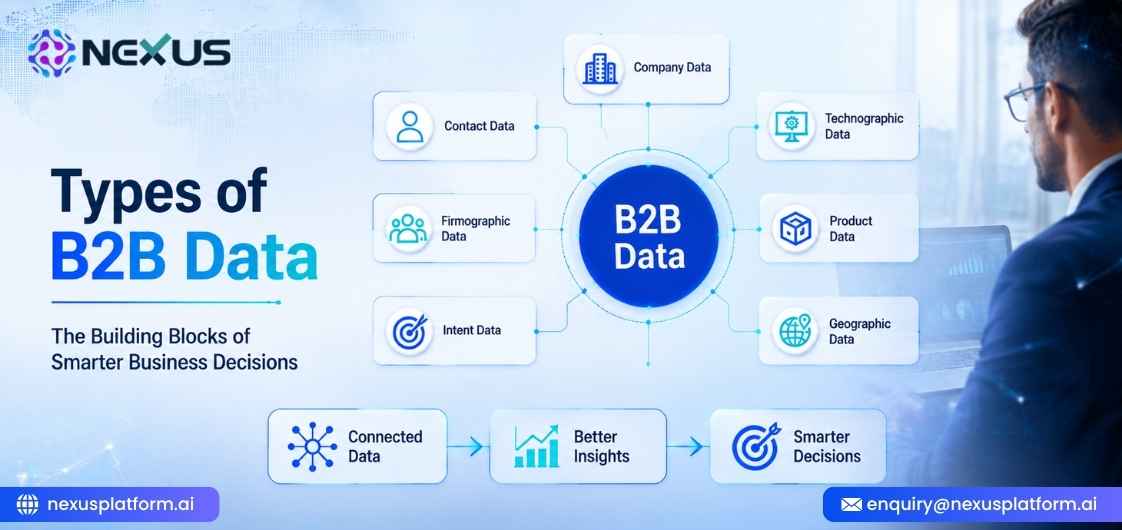
The main types of B2B data include company data, contact data, firmographic data, technographic data, intent data, product data, and geographic data. Together, these B2B data types give businesses a complete picture of a company, its people, its technology, and its market behavior.
Most organizations get the best results when they combine several of these data types rather than relying on just one.
Company Data vs Contact Data: What Is the Difference?
Company data and contact data are often confused, but they answer different questions.
Company data describes the organization itself. It typically includes:
- Company name and industry
- Employee count and annual revenue
- Headquarters location
- Year established
- Parent or subsidiary relationships
Contact data describes the people inside that organization. It typically includes:
- Executive names and job titles
- Departments
- Business email addresses
- Phone numbers, where available
In short, company data tells you which businesses to target, while contact data tells you who to talk to inside them. A sales team usually needs both to build a working prospect list.
Firmographic Data and Building an Ideal Customer Profile
Firmographic data groups businesses by shared characteristics, similar to how demographic data groups consumers. It typically includes industry, company size, revenue range, business model, ownership type, and growth stage.
Marketing teams rely on firmographic data to build an ideal customer profile, improve data segmentation, and personalize campaigns for the accounts most likely to convert. Without firmographic data, targeting tends to rely on guesswork rather than shared traits among your best customers.

Technographic Data and Intent Data: Reading Buying Signals
Technographic data reveals the technologies a company already uses, such as ERP systems, marketing automation software, cloud infrastructure, and analytics tools. This helps a software provider tailor messaging around compatibility instead of starting from a generic pitch.
Intent data works differently. Rather than describing who a company is, intent data highlights buying signals that suggest a company is actively researching a solution. Common intent signals include:
- Searching for industry-specific topics
- Downloading white papers
- Comparing software vendors
- Visiting product or pricing pages
Technographic data tells you what a company is already using. Intent data tells you whether they are actively looking for something new. Used together, they help sales and marketing teams prioritize accounts that are both a good fit and currently in-market.
Product and Geographic Data for Competitive Analysis
Product data provides detail on the products and brands a business develops, manufactures, or distributes, including categories, specifications, and target markets. Businesses use it for competitive analysis, supplier research, and market benchmarking.
Geographic data shows where a business operates, including headquarters, manufacturing facilities, branch offices, and distribution regions. A company planning to expand into a new region can use geographic data to identify businesses already operating there and evaluate potential partners.
Why Should Businesses Combine Multiple Types of B2B Data?
Each type of B2B data is useful on its own, but combining them is where the real value shows up.
Company data identifies organizations in a target industry. Firmographic data narrows that list by size or revenue. Contact data identifies the right decision-makers. Technographic data reveals what tools they use. Intent data shows whether they are actively researching a solution right now.
Connected this way, marketing campaigns become more relevant, sales outreach becomes more personalized, and strategic decisions become genuinely data-driven instead of based on a single, incomplete list.
Types of B2B Data for Food and Supplement Companies
Food and supplement companies rely on a few data types more heavily than most industries Product data matters for tracking ingredients, formulations, and certifications. Company data matters for identifying manufacturers, co-packers, and distributors within a specific category. Geographic data matters for sourcing suppliers in a particular region or meeting country-specific import requirements.
Combining these with firmographic data, such as company size and growth stage, helps sourcing and procurement teams in this industry evaluate suppliers with far more confidence than a basic contact list allows.
Choosing the Best B2B Data Provider for Firmographic and Intent Data
When running a B2B data enrichment tools comparison, look past contact counts and check whether a provider actually supports data segmentation software for B2B teams, or whether segmentation still has to be done manually after the fact. A tool that requires exporting records to a spreadsheet before you can segment by industry or company size is not really offering data segmentation software, it is just offering a list.
Also Read: Firmographic Data Explained: The Foundation of B2B Targeting

Best Practices for Using B2B Data
Collecting business data is only the first step. To maximize its value, businesses should focus on maintaining accurate, relevant, and up-to-date information.
Here are a few best practices:
- Verify business information regularly using trusted sources.
- Combine multiple types of B2B data instead of relying on a single dataset.
- Keep company records updated as businesses grow or change.
- Align data collection with your sales, marketing, or procurement goals.
- Review data quality periodically to reduce errors and duplicate records.
Following these practices helps organizations improve targeting, streamline research, and make more confident business decisions.
Also Read: Why Company Data Quality Determines Business Growth

Choose the Right Mix of B2B Data for Your Business
Understanding the different types of B2B data is essential for any business that wants to improve targeting and make confident, data-driven decisions. Company, contact, firmographic, technographic, intent, product, and geographic data each offer a distinct piece of the picture, and they become far more valuable when used together.
Nexus brings company, people, product, and certification data into one connected platform, with built-in segmentation and continuous verification across every data type.
Start your free trial with Nexus and see how the right mix of B2B data can sharpen your targeting.