Spreadsheets remain one of the most common tools for managing business data—but they may also be one of the biggest barriers to productivity.
Sales, procurement, marketing, and compliance teams often spend hours cleaning, organizing, and validating data before they can actually use it. These manual processes slow decision-making, introduce errors, and reduce operational efficiency.
If your team spends more time fixing data than acting on it, it's time to rethink your workflow.
The Hidden Cost of Messy Business Data
Poor-quality data doesn't just create frustration—it impacts business performance.
Every duplicate contact, missing email address, or outdated company record adds unnecessary work and increases the risk of poor decisions.
Over time, these inefficiencies lead to slower prospecting, delayed supplier approvals, lower campaign performance, and missed business opportunities.
Common Data Problems Businesses Face
Duplicate Contacts
Duplicate records create confusion, inflate CRM databases, and lead to repeated outreach efforts.
Missing Fields
Incomplete company information makes it difficult to qualify prospects or evaluate suppliers effectively.
Incorrect Emails
Outdated or invalid contact information results in bounced emails, reduced engagement, and lost opportunities.
Invalid Certifications
Working with inaccurate certification data can delay vendor approvals and increase compliance risks.
Multiple Spreadsheets
When different departments maintain separate files, teams work with inconsistent information and struggle to collaborate efficiently.
Also Read: The State of B2B Data Intelligence in 2026: 5 Trends Every Business Should Watch

Why These Issues Affect Revenue
Bad data has a direct impact on business growth.
Sales representatives spend valuable time chasing the wrong prospects.
Procurement teams take longer to verify suppliers.
Marketing campaigns target inaccurate audiences.
Leadership makes decisions based on incomplete information.
Instead of creating value, teams spend their time correcting avoidable errors.
How AI-Powered Validation Solves the Problem
Artificial intelligence transforms the way businesses manage data.
Rather than manually reviewing thousands of records, AI can automatically:
- Detect duplicate entries
- Identify missing fields
- Standardize inconsistent formats
- Flag inaccurate information
- Improve overall data quality
The result is cleaner, more reliable business intelligence that teams can trust.

How Nexus Automates the Process
Nexus simplifies business data management through intelligent automation.
Automatic Data Import
Import spreadsheets and external files without extensive manual preparation.
Smart Auto-Mapping
Nexus recognizes column structures and formats automatically, reducing setup time.
AI-Powered Validation
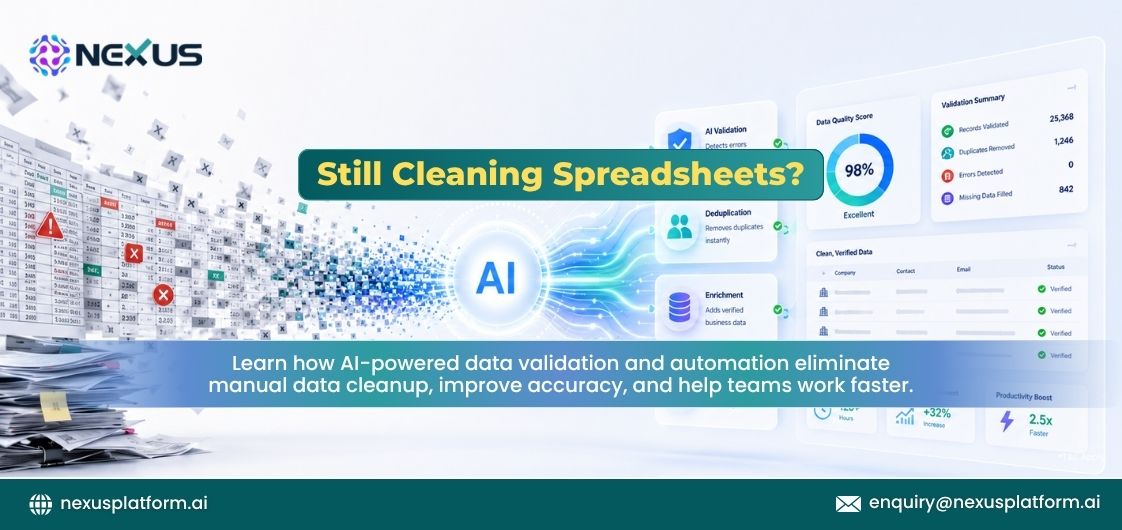
The platform identifies duplicates, formatting errors, missing information, and inconsistencies while providing accuracy insights.
Intelligent Deduplication
Duplicate records are detected and resolved before they impact sales, sourcing, or marketing workflows.
By eliminating manual data preparation, Nexus allows teams to focus on building relationships, evaluating suppliers, and growing the business.
Also Read: How to Find Verified Ingredient Suppliers Faster
Conclusion
Every hour spent cleaning spreadsheets is an hour not spent closing deals, sourcing trusted suppliers, or serving customers.
Businesses that automate data preparation gain faster workflows, higher-quality information, and better business outcomes.
With AI-powered validation, automatic data mapping, and verified business intelligence, Nexus transforms messy, fragmented data into a trusted foundation for smarter decisions and long-term growth.