Finding a company online takes seconds. Finding the right one, understanding it, and knowing whether it is worth pursuing takes something more. This is the future of B2B search: a shift from endless company lists toward B2B business discovery built on structured, verified, and connected information.
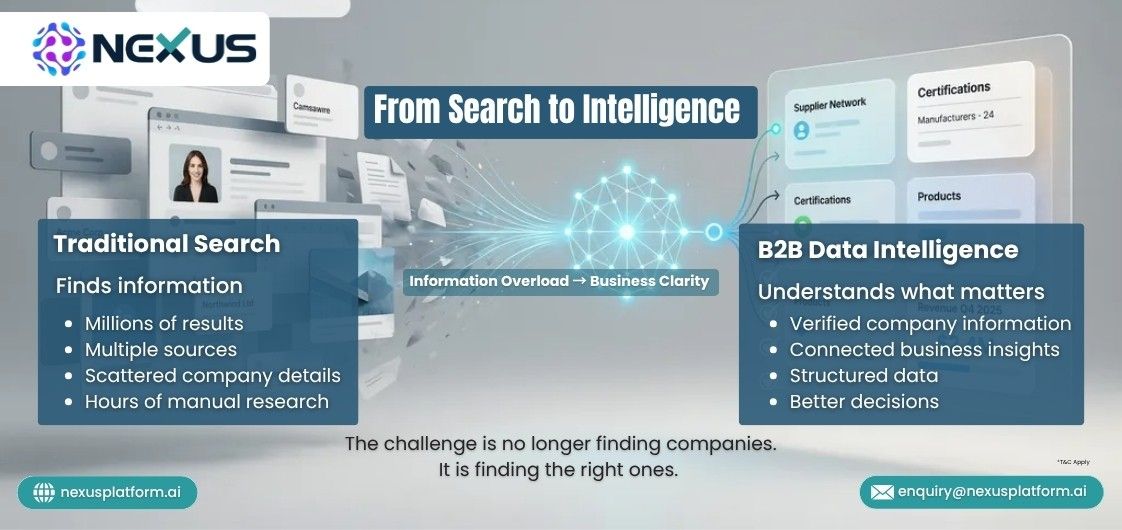
Search Was Built to Find Information, Not Make Business Decisions
Traditional search engines are excellent at surfacing websites, articles, and public information, but business decisions need more than a results page. A buyer evaluating suppliers needs to know what they offer, where they operate, and whether they are reliable, not just that they exist. A sales team looking for customers does not need thousands of random results either. It needs businesses that actually align with its goals, in the right industry, at the right size, and at the right stage of growth.
This is the difference between finding information and discovering opportunities, and it is exactly why B2B business discovery is evolving beyond keyword search toward a connected business data platform approach, where information is structured, verified, and turned into something usable.
The Hidden Challenge: Why Businesses Need Structured Business Data Platforms
A company profile tells you what a business is. A company intelligence platform tells you why that business matters, connecting products, market position, and business relationships into one picture instead of a name and an address.
Modern teams need more than a company name and a website. They need connected insights across products, capabilities, and opportunity, which is what separates the best company intelligence platform for B2B research from a static directory.
Consider a sales team trying to identify mid-market manufacturers expanding into a new region. A traditional search engine can surface company names and homepages, but it cannot show which of those manufacturers have the right production capacity, which markets they already serve, or which decision-makers to approach first. A company intelligence platform can return that same list filtered by capability, region, and contact readiness in a fraction of the time, turning a multi-day research project into a same-day shortlist.
Why a Verified Company Database Matters for B2B Decisions
Business information changes constantly: companies expand, offerings evolve, and markets shift. Working from outdated records leads to poor targeting, inefficient outreach, and missed partnerships, which is exactly the gap a verified company database is built to close.
A verified company database gives teams cleaner, more reliable information to build on, which is the foundation of decision-ready information rather than a list that needs to be double-checked before it is useful. Better information creates better decisions, and that starts well before the first outreach email is sent.
The Role of a B2B Data Platform in Modern Business Discovery
A modern business data platform brings company data, product information, industry insight, and market intelligence together in one place, so businesses can build market understanding instead of piecing it together from disconnected sources.
The goal is not simply finding data. The goal is business clarity, and that clarity is what business discovery software for sales teams should be measured against, not how many results a search returns. A platform that returns ten highly relevant, verified companies is more useful to a sales team than one that returns ten thousand unfiltered ones.

Why a Verified Company Database Matters for B2B Decisions
Business information changes constantly: companies expand, offerings evolve, and markets shift. Working from outdated records leads to poor targeting, inefficient outreach, and missed partnerships, which is exactly the gap a verified company database is built to close.
A verified company database gives teams cleaner, more reliable information to build on, which is the foundation of decision-ready information rather than a list that needs to be double-checked before it is useful. Better information creates better decisions, and that starts well before the first outreach email is sent.
The Role of a B2B Data Platform in Modern Business Discovery
A modern business data platform brings company data, product information, industry insight, and market intelligence together in one place, so businesses can build market understanding instead of piecing it together from disconnected sources.
The goal is not simply finding data. The goal is business clarity, and that clarity is what business discovery software for sales teams should be measured against, not how many results a search returns. A platform that returns ten highly relevant, verified companies is more useful to a sales team than one that returns ten thousand unfiltered ones.
AI-Powered Discovery Still Depends on the Data Behind It
AI is making it easier to process large amounts of information, but AI-powered discovery is only as good as the data feeding it. Unstructured or unverified information produces unreliable outcomes no matter how advanced the model behind it is.
The future is not more data plus AI. The future is structured data, verified information, and intelligent analysis working together, which is how B2B search is changing with AI in practice rather than in theory. A model trained on scattered, unverified records will confidently surface the wrong company just as easily as the right one, which is why the underlying data matters more than the algorithm sitting on top of it.
How Nexus Helps Businesses Move Beyond Search
Nexus is a connected company intelligence platform that helps businesses discover relevant companies, understand markets and company relationships, and turn scattered information into decision-ready information without the manual research that traditional search requires.
Nexus helps teams discover relevant companies aligned with specific goals, matching businesses, suppliers, and opportunities to the criteria that actually matter for a given search rather than returning a generic list. It helps teams understand business landscapes by exploring industries, markets, and company relationships side by side, so a single search surfaces context, not just contacts. It improves research efficiency by reducing manual data collection, freeing teams to spend their time on strategic decisions instead of verification work. And it turns raw business data into intelligence by transforming scattered records into insights that support growth, whether that means identifying a new supplier, a new market, or a new customer segment.
This is why company lists aren't enough for B2B research on their own, and why B2B research platform comparison shopping should weigh depth of data as heavily as breadth. A platform with a smaller but fully verified and structured dataset will often outperform one with a larger but shallow one.

Also Read:
Why Data Quality Matters in B2B Sales
How to Find Verified Ingredient Suppliers Faster