Every sale starts before the first conversation. Before outreach, before qualification, before pipeline, someone has to identify which businesses are worth pursuing in the first place. That is B2B prospecting, and it is where most sales efforts either gain momentum or quietly stall.
What Is B2B Prospecting?
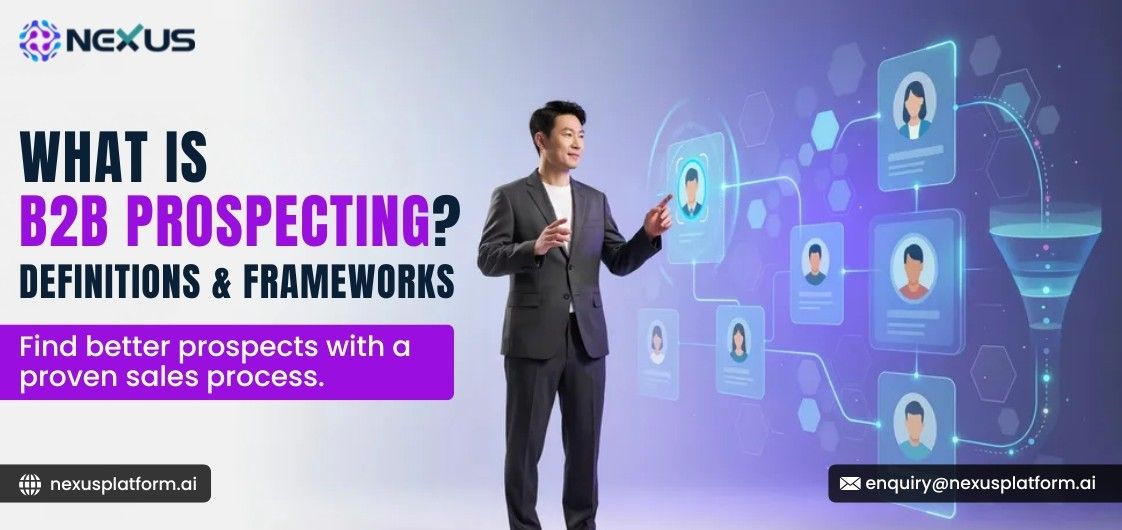
B2B prospecting is the process of finding, researching, and contacting potential business customers. It is the first step in building a sales pipeline and the foundation for future revenue growth.
The goal is not to generate a large volume of leads. It is to identify businesses that match an organization's ideal customer profile (ICP), so sales teams can focus their effort where it is most likely to convert. A modern B2B prospecting platform makes this easier by providing access to verified company information, decision-maker contacts, and market intelligence in one place, rather than scattered across spreadsheets and directories.
Why B2B Prospecting Matters
Without a consistent prospecting strategy, businesses struggle to maintain a predictable sales pipeline. Strong prospecting helps organizations generate qualified opportunities, reach decision-makers faster, improve sales productivity, and increase conversion rates, while reducing the time spent on manual research. The quality of prospecting directly determines the quality of leads entering the sales funnel, which is why it deserves as much strategic attention as outreach itself.
The Modern B2B Prospecting Process
Successful prospecting starts with defining the ideal customer profile. Common ICP criteria include industry, company size, geographic location, product focus, certification requirements, and business objectives. A clear ICP helps teams avoid wasting time on unqualified prospects before outreach ever begins.
Once the ICP is established, the next step is identifying target companies that match those criteria. This is where a structured business data platform becomes valuable, since it replaces manual searching across multiple directories with centralized, filterable company information.
From there, prospecting requires finding key decision-makers. B2B purchases often involve multiple stakeholders, so identifying the people responsible for purchasing, sourcing, operations, or strategic planning is central to decision-maker identification and to moving a deal forward without unnecessary delays.
Not every company that matches the ICP is ready to buy, which is where prospect qualification comes in. Qualification determines whether a prospect has a genuine business need, decision-making authority, budget availability, and the right timing. This step ensures sales teams spend their energy on the opportunities most likely to close.
Once prospects are identified and qualified, outreach can begin through email, phone, LinkedIn, or other channels. Accurate underlying data significantly improves the odds of reaching the right person and starting a meaningful conversation instead of a dead end.
Popular B2B Prospecting Frameworks
Sales teams commonly lean on one of three sales prospecting frameworks to structure qualification: BANT, CHAMP, and MEDDIC.
BANT stands for Budget, Authority, Need, and Timeline. It helps sales teams quickly determine whether a prospect is worth pursuing by checking the basics before investing further time.
CHAMP stands for Challenges, Authority, Money, and Prioritization. Rather than opening with budget, it starts by understanding the prospect's business challenges first, which tends to produce a more customer-centric conversation.
MEDDIC stands for Metrics, Economic Buyer, Decision Criteria, Decision Process, Identify Pain, and Champion. It is built for complex B2B sales environments with longer cycles and multiple stakeholders, where a simpler framework like BANT can miss important detail.
There is no single correct framework. The right choice depends on deal complexity, sales cycle length, and how many stakeholders are typically involved in a purchase decision.
Common B2B Prospecting Challenges
Most sales teams run into the same obstacles. Business information changes constantly, and outdated company details or contact information lead to targeting the wrong person. Finding the actual decision-maker inside a target account can be time-consuming on its own. Many teams still rely on spreadsheets and fragmented databases, which slows the whole process down, and poor data quality, duplicate records, incomplete profiles, and inconsistent formatting, quietly erodes sales productivity even when the process itself is sound.
These challenges are exactly why modern sales teams are shifting toward data intelligence solutions instead of manual research.
How Data Intelligence Improves Prospecting
A B2B data intelligence platform helps teams access verified company information, identify decision-makers, validate business records, improve lead qualification, and discover new market opportunities. With reliable business intelligence behind the process, sales teams spend less time researching and more time engaging prospects who are actually ready for a conversation.
Prospecting is not limited to finding buyers, either. Many organizations also need to identify suppliers, partners, and adjacent market opportunities, which is where supplier discovery and product or ingredient data become part of the same intelligence layer rather than a separate research effort.
How Nexus Supports Smarter Prospecting
Nexus Platform AI helps businesses simplify prospecting through a connected intelligence layer that combines 10M+ companies, 12M+ decision-makers, 2M+ products, 3M+ ingredients, and certification records into a single ecosystem.
Teams can use Nexus as a verified company database to identify qualified prospects, validate information, and discover new opportunities faster, while the same dataset supports supplier research and market visibility across products and ingredients. Centralizing these datasets means faster research, better targeting, and more informed decisions at every stage of the sales pipeline.

Popular B2B Prospecting Frameworks
BANT Framework
One of the most widely used prospecting frameworks is BANT:
- Budget
- Authority
- Need
- Timeline
BANT helps sales teams quickly determine whether a prospect is worth pursuing.
CHAMP Framework
CHAMP focuses on understanding business challenges before discussing budgets.
It stands for:
- Challenges
- Authority
- Money
- Prioritization
This framework encourages a more customer-centric prospecting approach.
MEDDIC Framework
MEDDIC is often used in complex B2B sales environments.
It includes:
- Metrics
- Economic Buyer
- Decision Criteria
- Decision Process
- Identify Pain
- Champion
MEDDIC helps organizations manage longer sales cycles and multiple stakeholders more effectively.

Also Read: Why Data Quality Matters in B2B Sales
Conclusion
B2B prospecting is not a numbers game, it is a targeting problem. The teams that consistently build strong pipelines are not the ones sending the most outreach. They are the ones reaching the right companies, at the right time, with the right message.
That starts with a clear ICP, a structured process, and a framework that matches the complexity of the sale. None of it works without reliable data underneath it. Verified company records, direct decision-maker contacts, and market intelligence give sales teams the foundation they need to move faster, qualify better, and convert more.