The Consequences of Wrong Supplier Data in Cross-Border Trading
Finding the right supplier is only half the battle in the complicated world of global trade. With thousands of suppliers available to businesses around the globe, the difficult part is ensuring that all supplier data is accurate, kept up to date, and trustworthy.
Losing touch with suppliers may mean you have expired certifications. You may also lose valuable suppliers who can no longer meet your needs if they have changed their means of production. For businesses in the Food and Beverage, Pharmaceuticals, Nutraceuticals, and Cosmetics, the exposure to supplier data means delays and costly compliance and supply chain risks.
This article is about the hidden exposure of the use of dated supplier data and the increasing need of supplier data intelligence and verification in the world of modern procurement.
How and Why Supplier Data Changes Rapidly
Many procurement agents believe that once a supplier is evaluated and approved, that supplier can be taken off the list and all data remains unchanged and reliable for years.
This belief is wrong.
The constant changes to the business environment cause companies to adapt. Changes to suppliers can happen in the time it takes to process a single order.
Some of these changes may be:
- New or Expanding Production Facilities
- New or Changes to Ownership or Senior Management
- Changes to the Product Portfolio
- Changes to Production Capacities
- New and Expired Certifications
- Changes in the Export Markets
- Changes in Key Personnel and Contact Information
Transformation in data, no matter how minor, can and will impact the greater procurement process.
The Hidden Cost of Data Decay
One of the major issues faced by procurement is data decay, the loss of the accuracy of business data over time.
Supplier records are not permanent. They need to be updated to retain their usefulness.
For example, a manufacturer can:
- Relocate the site of their production
- Develop new product lines
- Leave various markets
- Merge with other manufacturers
- Gain new regulatory approvals
- Intake new certifications
- Change their procurement or sales teams
If procurement teams rely on old supplier records, they will be choosing based on data that is no longer accurate.
Data decay typically does not cause a major issue. Rather, it will cause a collection of small problems in the procurement process that, over time, will cause significant disruption.

Why Outdated Supplier Information Is More Than an Administrative Issue
Supplier data decay is, unfortunately for many organizations, seen as an administrative issue pertaining to supplier data management as opposed to impacting the procurement process.
The sourcing procurement process is disrupted by the decay of supplier data.
Supplier Discovery
The procurement team may waste time evaluating a supplier that no longer produces the goods.
Supplier Verification
Outdated compliance documentation increases regulatory exposure.
Supplier Selection
Inaccurate information about production constraints may lead to the selection of a supplier who is unable to fulfill demand.
Supplier Relationship Management
Data decay impacts communication, causing delays in the sourcing cycle.
Risk Management
Changes in ownership or supplier stability are overlooked, impacting the long-term reliability of suppliers.
An example of an advanced element in procurement today is supplier intelligence, as opposed to traditional elements of procurement, where the emphasis was on routine tasks.
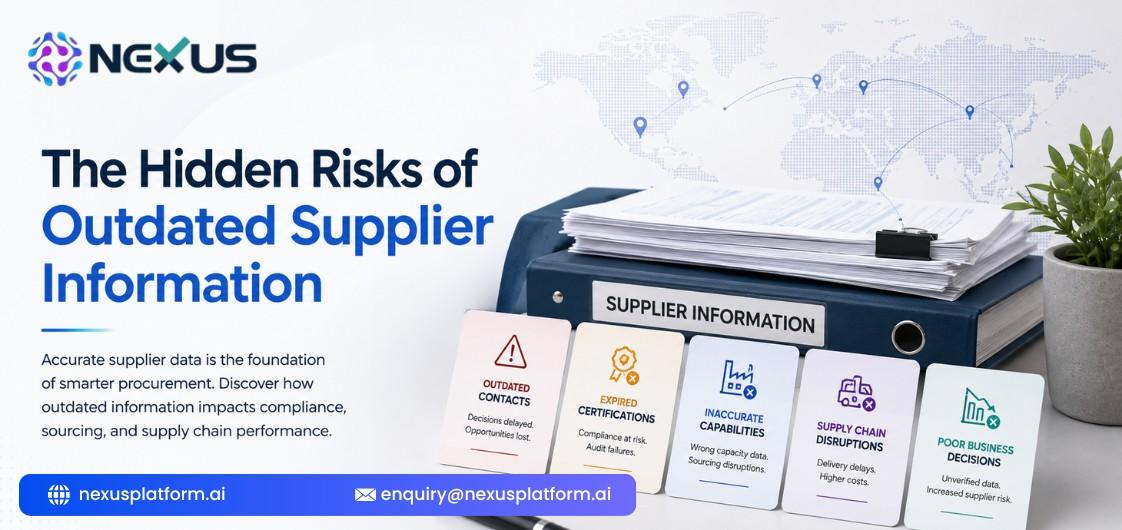
Five Cloaked Dangers of Old Supplier Data
Using old supplier data doesn’t necessarily result in obvious immediate problems. As a rule, it manifests as concealed risks that detrimentally affect procurement, supplier relationships, and business operations.
Procurement Disruptions from Outdated Information
The most common issue is Information that changes and is not updated.
Employees may move to different positions, departments may merge/ may be dissolved, and decision makers may leave. However, supplier databases and internal spreadsheets may not be updated accordingly.
The procurement process may result in wasted days attempting to contact people who no longer hold procurement positions.
This may result in the following:
- Delayed RFQ responses
- Time-bound sourcing not achieved
- Time-bound Procurement not achieved
- Cycle times for Procurement stretch beyond reasonable limits
- Procurement process becomes less efficient.
Although each of these may appear on the surface to be a minor issue, in a larger context of multiple sourcing projects in different environments, they are major issues.
Compliance and Risk Accounts for Expired Supplier Certifications
When Supplier Evaluations is a primary service of the following industries, Supplier Certifications are of key importance:
- Nutraceutical
- Dietary Supplements
- Hospitality and Healthcare
- Food and Beverage
Once obtained, supplier certifications are not permanent.
They will require renewal, audits, and compliance will be assessed continuously.
Examples include:
- GMP
- ISO 9001
- HACCP
- FSSC 22000
- USDA Organic
- Halal
- Kosher
Managing supplier certifications relies on the certification renewal process in order to minimize regulatory, compliance, and reputational risk.
Verification of a supplier’s certification should not be considered a one-off event during the onboarding process. Instead, it should be treated as part of an ongoing process.

Manufacturing Capability Misrepresentation
Supplier capability information is no longer static. There is always the possibility for manufacturers to increase or reduce the lines of products they manufacture. They may also decide to outsource their processes or relocate to a completely different site.
If procurement teams depend on out-of-date capability information, they may:
- Assume a supplier has a greater capability to manufacture than they actually do,
- Select suppliers who are unable to meet the necessary quality standards,
- Be subject to longer lead times than anticipated,
- Experience disruptions to their own manufacturing processes.
This is especially pertinent within the Biotechnology, Chemical, and Personal Care sectors, as the manufacturing capabilities of a supplier may impact a product’s quality and a company’s compliance with regulations.
Conclusion
In today’s world, fast-paced and high competition markets, streamlined procurement practices rely on having accurate information on suppliers. Using out-of-date information increases the risk to your supply chain, slows down your procurement process, and causes issues with compliance, regardless of the industry.
By implementing ongoing supplier verification and using dependable supplier insights, companies can refine their procurement processes, enhance the reliability of their suppliers, and cultivate valuable partnerships with suppliers. As international trade becomes more focused on utilizing available data, maintaining up-to-date supplier information will be a necessity for pr companies and will serve as a clear competitive advantage.